Is Mississippi really richer than France?

A Wall Street Journal op-ed (link) recently ignited a transatlantic debate with a provocative headline: "What Happens When Europeans Find Out How Poor They Are?" The claim seemed perfect to profoundly annoy the European sense of superiority with respect to the world’s economic powerhouse. After all, anyone strolling through Paris, Copenhagen or Amsterdam is likely to experience the richness of their surroundings, possibly even more than if they were strolling through downtown Jackson, Mississippi. Yet the statistics behind the headline are real: since the turn of the century, the United States has pulled decisively ahead of Western Europe on most conventional measures of GDP per capita and productivity.
GDP per capita at constant prices has increased much more in the US than in France or Germany (see below).

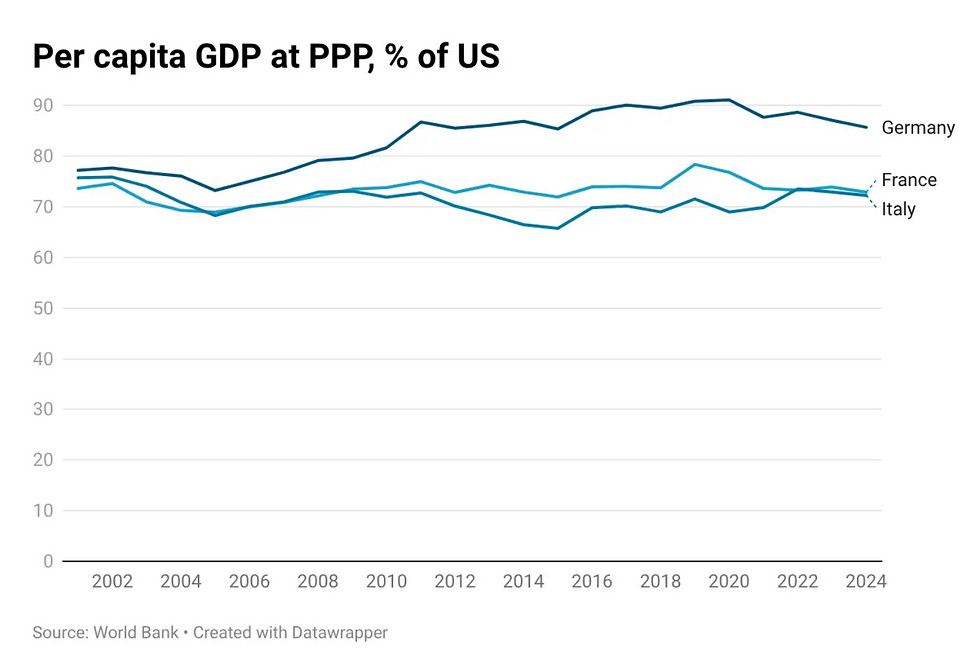
At the same time, GDP recalibrated at PPP (i.e., focusing on purchasing power) does not seem to have dropped (see below).
The ensuing debate among economists—including Paul Krugman, Luis Garicano and recent Nobel-prize winner Philippe Aghion—revealed something more interesting than the original provocation, unpacking a series of very basic questions when comparing the US with Europe.
The first question is whether Europeans are materially poorer than Americans. As a (Southern) European, it saddens me to say that the answer to this questions is very simple, and affirmative. Measured by GDP per capita or output per hour, the answer is “yes” for most of Western Europe. But Europe is not one economy, as shown by Garicano and Olivier Kooi (2025), many Eastern European countries such as Poland, Romania and the Baltic are rapidly converging toward U.S. income levels, while “old-money” Europe such as France, Italy, Spain and Portugal have slipped backwards relative to the American frontier (see graph below). The European story is therefore one of simultaneous convergence within Europe and divergence from the United States.

The second issue is whether Europe is stagnating. Here according to 2008 Nobel prize winner Paul Krugman caution is needed. Conventional measures of real GDP growth favour the United States, but they typically compare real GDP at current prices; this method prices (for example) today's software and digital output at yesterday's prices, amplifying the apparent contribution of sectors where prices have collapsed. This implies that those economies which are stronger in innovative sectors, where prices have collapsed and productivity surged, appear stronger according to this statistics. This is particularly relevant in this historical moment, when most of US economic growth is coming from the IT sector. This methodology, though, is not useful if one wants to compare today’s standards of living, which are better measured by the purchasing power. Using this alternative methodology the discrepancy is much smaller.
As argued by Garicano, Bergeaud and Aghion (2026), if the US (according to the first statistics we cited) are constantly more innovative and with higher productivity growth, surely this in time will substantiate into wealth differentials. Current purchasing-power parity is appropriate for comparing countries at one moment in time, but it is a poor guide to changes in productive capacity over decades. The other issue highlighted by Garicano, Bergeaud and Aghion (2026) is that as the most innovative sector become more productive, they will offer better and better wages, and this wage growth is bound to spill over also in other sectors, following the old “Balassa-Samuelson” effect. This in short, will raise standards all over the economy also beyond the fast-growing sectors.
It may sound like a disagreement on technicalities, but this has important political consequences. Krugman is asking whether standard productivity measures map cleanly onto welfare (“what’s the use for the average man or woman if Bezos, Musk and their engineer are getting so rich?”). Garicano is asking whether Europe has remained close to the technological frontier, and how long can it maintain its “lifestyle” if it’s constantly lagging behind.
Further, this gap in income and productivity may also hide different “lifestyle choices”. Europeans work fewer hours, enjoy longer vacations, benefit from universal healthcare and often report life satisfaction comparable to Americans despite lower incomes. Higher GDP does not automatically translate into greater happiness. Europe and America have chosen somewhat different bundles of income, leisure and security.
Yet none of this makes the productivity debate irrelevant. As pointed out by Mario Draghi on his competitiveness report, the issue is not about whether Europeans live well today, but whether Europe can continue financing its preferred social model while also paying for the increasing demands coming from geopolitical and demographic pressures.
Europe's social model has flourished during decades in which America supplied a disproportionate share of frontier innovation. If future breakthroughs in artificial intelligence, biotechnology and advanced manufacturing remain concentrated elsewhere, Europe may eventually find that preserving its social contract requires generating more innovation itself.
The lesson is therefore neither triumphalist nor complacent. It is correct that Western Europe has become relatively poorer than America on conventional economic measures, but productivity statistics are often misunderstood and should not be conflated mechanically with welfare. Innovation and productivity ultimately matter for long-run prosperity, but living standards encompass far more than GDP alone.
Europe faces the harder question of whether it can preserve a high-quality social model while drifting away from the technological frontier.
Suggested figure references
Aghion, Philippe, Antonin Bergeaud, and Luis Garicano. 2026. “The Mismeasurement of Europe’s Productivity.” Project Syndicate, May 29, 2026.
Draghi, M. (2024). The future of European competitiveness: A competitiveness strategy for Europe. European Commission.
Garicano, Luis, and Olivier Kooi. 2025. “The Two Europes: Europe’s Security Shock Is Deepening Its Economic Divide.” Silicon Continent, May 7, 2025. https://www.siliconcontinent.com/p/the-two-europes.
Krugman, Paul. 2026. “Modeling the US-Europe Paradox (Very Wonkish).” Paul Krugman (Substack), May 12, 2026. https://paulkrugman.substack.com/p/modeling-the-us-europe-paradox-very.