


School Exclusion: A Disciplinary Tool With No Proven Upside
- Dr Joan Madia

- Apr 27
- 7 min read
School exclusion, whether a fixed-period suspension or a permanent removal, is one of the most consequential decisions an educational system can make about a child. Its underlying purpose is straightforward: to interrupt a pattern of disruptive or harmful behaviour, and to redirect a young person towards a better path. If exclusion worked, we would expect to see some sign of that redirection in the lives of excluded pupils in terms of improved conduct, better engagement with learning, stronger outcomes in adulthood. What the evidence shows instead is a consistent, sobering absence of any such effect.
Children who are excluded from school tend to arrive at that point already carrying significant disadvantage like poverty, family instability, mental health difficulties, unmet learning needs. That is well established. What is equally well established, and far less often acknowledged, is that exclusion does nothing to interrupt the downward trajectory those children are already on. By the time they reach adulthood, excluded young people are faring worse across almost every measure of health, well-being, and economic security that researchers have examined. The intervention intended to help them has, at best, left them exactly where they were headed. At worst, it has made the journey there faster.
Already Struggling — and Then Falling Further
The children most likely to be excluded are those who most need support. They disproportionately come from low-income families, have special educational needs, face mental health difficulties, or belong to ethnic minority groups that have long been overrepresented in exclusion statistics. In other words, they are children on a difficult trajectory before any disciplinary decision is made. The purpose of education, and of any intervention within it, is to improve those trajectories, or at least to slow their deterioration.
Exclusion fails this basic test. Research following excluded young people from their teenage years into adulthood finds that, far from turning things around, their life outcomes are poor across the board. They are significantly more likely to experience severe psychological distress, longstanding physical health problems, poor sleep, and deep dissatisfaction with life. They are more likely to smoke, less likely to exercise. They are more likely to be out of work, economically inactive, or in precarious low-paid employment. Even those who find their way into work tend to earn considerably less than peers from similarly difficult starting points who were not excluded.
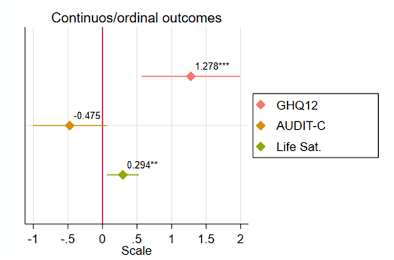

By their mid-twenties, permanently excluded young people showed significantly higher rates of severe psychological distress, longstanding health conditions, daily smoking, and very poor sleep, and were considerably less likely to engage in regular sport; compared to peers from similarly disadvantaged backgrounds who were never excluded. Source: Obsuth et al., 2024, British Journal of Educational Psychology.
The economic picture is just as stark. Excluded young people are more likely to be out of education, employment, or training in the years immediately after leaving school, and that gap does not close as they get older. At 25, they remain more likely to be unemployed or economically inactive, and those who do work earn substantially less. Crucially, these patterns hold even when comparing young people who attended the same schools, which means the outcomes cannot be explained simply by the quality of the institutions involved.

The most important thing to note about these findings is not what they prove about exclusion specifically, but what they demonstrate about exclusion's failure. These are children who were already at risk. The whole point of any educational intervention, including a disciplinary one, is to improve their chances, or at a minimum not to worsen them. Yet at every stage of life that researchers have examined, excluded pupils are doing no better than a declining trajectory would predict. The spiral continues; exclusion does not interrupt it.
Establishing causality in this context is, of course, difficult. Exclusion is not randomly assigned; it is applied to children who are already facing significant challenges, and disentangling the effect of the intervention from the trajectory they were already on requires careful research design. But this limitation does not weaken the pattern described above. Even when excluded pupils are compared with peers from similarly disadvantaged backgrounds, including within the same schools, there is no evidence that their outcomes improve. Across the very domains just outlined, health, well-being, and economic prospects, exclusion is not associated with any positive deviation from the expected trajectory. At best, outcomes are no better than would have been predicted; at worst, they are worse. The absence of any detectable improvement is itself a striking finding.
Does Exclusion at Least Help the Students Who Remain?
A common justification for exclusion is that, whatever its costs for the pupil removed, it restores a calmer and more productive environment for everyone else. Here too, the evidence offers limited and inconclusive support. Research examining school climate, how safe students feel, how well teachers can teach, and the general atmosphere of learning, does not consistently find meaningful improvements following exclusion. However, the evidence base remains relatively limited, and more research is needed to establish whether, and under what conditions, exclusion might improve learning environments for those who remain. What can be said is that schools with higher use of exclusion are not systematically safer or more effective, and in some cases a culture centred on removal and punishment may undermine the trust and sense of belonging that supports learning.
No Sign of Improvement, but a Very Clear Cost
Perhaps the most telling feature of the available evidence is not what it finds, but what it consistently fails to find: any point in the life course at which excluded young people are faring better than would be expected given where they started. Across health, well-being, employment, and economic security, the picture is one of unbroken continuity with disadvantage; disadvantage that exclusion was presumably intended to disrupt, and did not.
This matters because exclusion is not a neutral act. It consumes school and local authority resources, triggers legal processes, and carries profound psychological weight for children and families. Estimates suggest that each permanently excluded young person costs the state around £370,000 over a lifetime, through the combined effects of lower earnings, greater benefit dependency, higher healthcare use, and greater contact with the justice system. A disciplinary measure that achieves none of its stated goals while generating costs on this scale deserves serious scrutiny.
A System That Fails Before and After
The failure of exclusion to improve outcomes cannot be separated from two broader failures in the system: the failure to identify and support struggling children before exclusion becomes the only option being considered, and the failure to offer anything genuinely useful once they have been removed.
Exclusion is not distributed randomly. It consistently falls hardest on children who already face the greatest obstacles. Children eligible for free school meals are four to five times more likely to be permanently excluded than their better-off peers. Children from certain ethnic minority backgrounds, including Black Caribbean and Gypsy/Roma pupils, are excluded at rates far above the national average. Children whose mental health needs are formally recognised are seventeen times more likely to end up educated outside a mainstream school than to appear in the general school population. These children are not, by and large, being excluded because of sudden or inexplicable breakdowns in behaviour. They are reaching the end of a road that their schools and the wider system failed to redirect them from much earlier.
The scale of the problem is growing. The suspension rate across English schools in 2023/24 exceeded 11%, more than double the pre-pandemic level. Over 32 million days of learning were lost in a single academic year through exclusions and unauthorised absences; equivalent to every child in two cities the size of Liverpool missing school every day for a year.
What happens after exclusion offers little reassurance. The alternative educational settings to which excluded pupils are directed produce outcomes far below those of mainstream schools. Only around one in twenty-seven pupils completing their secondary education in these settings achieves a passing grade in both English and Maths, compared to almost two in three in mainstream. More than two thirds are not in sustained education, training, or employment five years after leaving school. There is, at present, no settled understanding of what effective provision for excluded pupils looks like, and what is on offer varies enormously and often arbitrarily depending on where a child happens to live.
Towards a Different Approach
If exclusion is failing to change trajectories, the question becomes what would. The answer the evidence points towards is not more sophisticated versions of the same response, but an earlier and more sustained one. Identifying children showing signs of emotional, social, or behavioural difficulty before those difficulties reach crisis point; providing coordinated support that brings together schools, families, mental health services, and social care; and building school environments in which all children, including the most challenging ones, are understood as belonging there.
This requires investment in the conditions that allow schools to respond to difficulty without removal: trained staff with the time and knowledge to recognise what lies behind a child's behaviour; access to specialist services before things escalate; and a shared understanding across the education system that a child's conduct is rarely the whole story. It also requires a genuine rethinking of what excluded pupils are offered, so that alternative provision becomes a meaningful educational experience rather than a place to manage children until they are old enough to leave.
None of this is straightforward, and none of it is cheap. But the evidence is clear on one point: what is being done now is not working. Children are arriving at school already on a difficult path, being excluded for behaviour that is almost always a symptom of something deeper, and emerging at the other end no better off than if the intervention had never happened. A system that cannot interrupt a declining trajectory, and may in some cases accelerate it, is not protecting anyone. It is passing the problem on.
Key References
Obsuth, I., Madia, J.E., Murray, A.L., Thompson, I., & Daniels, H. (2024). The impact of school exclusion in childhood on health and well-being outcomes in adulthood. British Journal of Educational Psychology, 94, 460–473.
Madia, J.E., Obsuth, I., Thompson, I., Daniels, H., & Murray, A.L. (2022). Long-term labour market and economic consequences of school exclusions in England. British Journal of Educational Psychology, 92, 801–816.
American Institutes for Research (2021). Study finds more severe suspensions have greater negative effects on academic outcomes, attendance and future behavior.
IPPR (2024). Who is Losing Learning? Institute for Public Policy Research.
House of Commons Library (2025). Alternative education provision in England (CBP-10617).
Learning Policy Institute (2024). Pushed Out: Trends and Disparities in Out-of-School Suspension.
IntegratED (2024). Fewer exclusions. Better alternative provision. Annual Report 2024.


