Social Media Beyond Interaction: Transforming Consumption, Communication, and Control

Executive Summary
This article explores how the rapid evolution of social media is transforming consumer behavior and business strategies. It illustrates that social media has transitioned from a mere communication tool to an essential part of digital infrastructure that shapes markets, influences information searches, drives purchasing decisions, and affects brand interactions. Notable developments include the emergence of “social search,” the rise of community-driven consumption fueled by herd behavior and fear of missing out (FOMO), and the growing significance of real-time customer engagement.
Simultaneously, businesses are increasingly leveraging social media, although the degree of adoption varies by company size, industry, and context. The article emphasizes both opportunities, such as enhanced engagement, the emergence of new intermediaries, and digital innovation, and challenges, including platform dependency, inequality, and reputational risks. In conclusion, it argues that social media is fundamentally altering market dynamics, compelling firms to adopt more adaptive and critically informed digital strategies.
1.0 Introduction
The nature of interactions between businesses and consumers is increasingly influenced by the growing presence of digital technology in our daily lives. As we enter the third decade of social media, these platforms are evolving and integrating a diverse range of digital tools, including AI, to extend their role beyond merely connecting people and providing entertainment. Businesses are leveraging these platforms for communication, engagement, and product sales. In response, consumer markets are adapting their expectations, purchasing choices, and behaviors to this evolving landscape. While the overall impact of social media on businesses and markets has become somewhat cliché and is widely recognized, there are many intricate and subtle emerging dynamics that warrant closer examination.
Evidence from the Sprout Social UK statistics report underscores the increasing significance of social media in information search, commerce, and customer engagement, reflecting evolving consumer behaviors and expectations. In addition, recent EU data indicate that a majority of enterprises are now leveraging social media to enhance their market presence, communication, and collaborative efforts. Collectively, these insights illustrate a broader shift in markets toward interactive, platform-driven ecosystems. This article examines these trends from both consumer and business perspectives.
2.0 The evolving nature of customers’ interaction with the digital world
The recent survey findings provide insights into the digitally mature and continually evolving social media landscape. Its key findings, such as the emergence of “social search,” the expansion of social commerce, and rising expectations for real-time brand responsiveness, indicate that social media has moved beyond a simple communication channel to become a central component of everyday economic, cultural, and informational life.

The concept of social search
One of the most striking findings is the shift towards “social search,” with 43% of UK consumers using social media daily for information retrieval, and Gen Z particularly reliant on it. This signals a fundamental transformation in the architecture of digital information flows.
This trend indicates that social media platforms are no longer merely intermediaries of content—they are becoming primary epistemic authorities. Users increasingly privilege user-generated, experiential knowledge (e.g., reviews, tutorials) over institutional or algorithmically curated knowledge (e.g., search engine results). This aligns with broader shifts towards peer-based trust systems and the decline of traditional information gatekeepers.
These trend has its inherent challenges such as accuracy related challenges and risks of misinformation. Unlike search engines, where ranking logic is more formalised, social media discovery remains opaque and driven by engagement signals. Businesses must now optimise for platform-specific “search behaviour,” increasing dependence on privately governed ecosystems.

Social Commerce and the “Community Economy”
The growth of social commerce, with platforms like TikTok becoming major purchasing hubs and users increasingly influenced by creators and community recommendations. This reflects the emergence of what can be termed a “community-driven consumption model.” The diffusion of product information is faster than ever, impacted by what is often termed ‘herding effect’ (following other people) and ‘fear of missing out’ (FOMO) (feeling of anxiety or worry that you might miss out on something enjoyable, valuable, or important that others are experiencing).
As a result, discovery, evaluation, and purchasing are increasingly taking place in a communal context. Furthermore, economic value is being reallocated toward creators and influencers who facilitate trust between brands and consumers, giving rise to a new type of intermediary. There is also a notable shift in economic activities from traditional commercial entities to individuals. We are observing a growing prevalence of customer-to-customer (C-to-C) communication and interactions, which complement conventional business-to-business and business-to-consumer interactions. Consequently, purchasing decisions are increasingly influenced by perceived authenticity and community endorsement rather than by product attributes alone.
While this trend offers significant opportunities, it also comes with notable caveats. Influencer marketing often blurs the lines between genuine endorsement and paid promotion. Influencers may not possess the same level of professionalism and resilience as traditional commercial entities, which introduces a degree of volatility. Additionally, community-driven reputations can be fragile and may quickly change in response to viral backlash or reputational crises. There are also equity concerns to consider. Although social media appears to democratize access by allowing smaller firms to reach customer markets, this is often an illusion. Smaller brands without influencer partnerships may find it challenging to compete in attention-driven markets.
The Intensification of Consumer Expectations
Seventy-one percent of users in the UK would consider switching brands if their inquiries on social media go unanswered. This statistic underscores the growing importance of social media in customer service. It reflects a broader shift toward expectations for continuous service, with social media serving as a vital channel for customer support, a tool for reputation management, and a mechanism for public accountability. Theoretically, this aligns with the concept of "platform-mediated immediacy," in which compressed time expectations mean that response delays can be a significant competitive disadvantage.
However, this trend raises several challenges, such as operational strain, emotional labour, and amplified reputational risk. SMEs may lack the resources to maintain real-time responsiveness, creating asymmetries between large and small firms. Furthermore, negative interactions are publicly visible, escalating minor service issues into brand crises.
High Penetration, Low Growth: A Saturated Market
There is a concern about the slow growth of social media users. There is also social media fatigue. Businesses have to be more cautious about how they present themselves on social media due to these shifts.
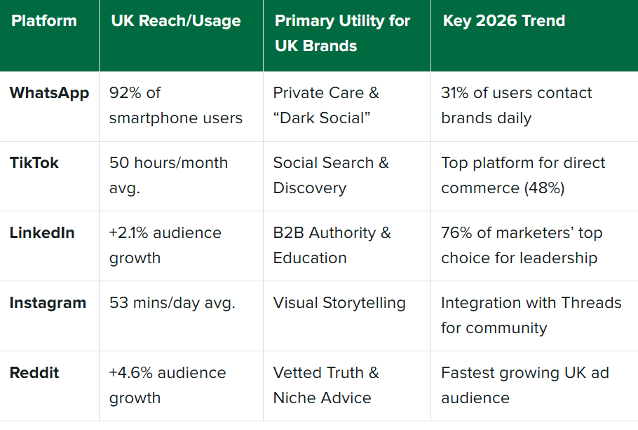
Platforms are increasingly competing not merely for user acquisition but for attention and the depth of user engagement. The focus of innovation has transitioned from mere expansion to differentiation of features and monetization strategies. As various engagement metrics are developed and employed, competition among platforms to enhance user engagement has intensified.
Generational and Behavioural Fragmentation
Social media engagement is characterized by generational differences, particularly with Gen Z playing a significant role in shaping trends like social search and platform preferences. This illustrates a wider trend of audience fragmentation, where various demographic groups utilize platforms for specific purposes. The choice of platform is influenced by intent—be it for discovery, research, or social interaction. This challenges the conventional "one-platform strategy" and underscores the necessity for multi-platform differentiation and the creation of audience-specific content.
Platform Power and Market Dynamics
The report highlights the emergence of specific platforms, such as TikTok for commerce and Reddit as a rapidly growing contender, illustrating significant shifts in platform dominance. This trend reflects a reconfiguration of platform hierarchies, influenced by algorithmic innovations, the rise of new content formats such as short-form video, and shifting user expectations. Nonetheless, this dynamism also emphasizes the swift transformations in reach and relevance, strategic dependence, and the implications of algorithmic governance. While the report presents platform growth as a trend, it adopts a critical perspective that underscores businesses' structural reliance on platform ecosystems.
3.0 Firm response to emergent social media dynamics
A key development evident in recent data is the steady increase in enterprises’ use of social media. By the early 2020s, a clear majority of businesses were engaging with at least one form of social media, reflecting a substantial rise over the previous decade. Within this overall trend, social networking platforms are the most widely adopted, signalling a broader shift away from static, web-based communication towards interactive, user-driven digital environments that enable real-time engagement, collaboration, and knowledge exchange. In this context, social media has become a central infrastructure through which organisations manage their public image, communicate with customers, and generate market intelligence.

At the same time, adoption patterns vary significantly across different national and organizational contexts. Cross-country comparisons reveal that some economies demonstrate exceptionally high levels of enterprise social media usage, while others significantly lag behind, highlighting persistent disparities in digital transformation among advanced economies. Additionally, firm size is a critical factor influencing adoption rates. Larger enterprises are far more likely to utilize social media and engage across multiple platforms, whereas smaller firms generally show lower adoption rates and more limited diversification in their social media strategies. These trends indicate that differences in resources, capabilities, and strategic priorities significantly shape how businesses interact with digital platforms.

The data highlight distinct modes of social media usage, which can be categorized into three broad types: general-purpose social networks, multimedia content-sharing platforms, and blogs or microblogs. Among these, social networks prevail primarily because they facilitate direct interactions, cultivate brand communities, and enable users to engage in value creation and feedback processes. Content-sharing platforms—especially those focused on visual media, have likewise seen steady growth, reflecting an increasing emphasis on image and video-based communication. In contrast, text-oriented formats like blogs and microblogs appear to be less prominent, demonstrating a relatively limited adoption of longer-form or text-heavy communication tools within organizational practices.
Over time, growth has been apparent across all categories, albeit at different rates. Social networking platforms have seen the most significant expansion, followed by content-sharing platforms, while blogs have exhibited only modest growth. This trend reflects a broader shift towards more immediate, interactive, and visually-driven forms of communication, aligning with changing user preferences and platform ecosystems.
Sectoral differences further emphasize the contextual nature of social media adoption. Industries with high levels of customer interaction or digital connectivity tend to exhibit the greatest use of social media, particularly on networking and content-sharing platforms. Conversely, sectors that engage less directly with consumers or operate with more focused business models often demonstrate lower adoption rates, especially for interactive or content-intensive formats. These variations underscore how the perceived value of social media is influenced by foundational business models and patterns of stakeholder interaction.

Finally, these developments are intricately tied to broader digital transformation initiatives advocated at both regional and international levels, which prioritize innovation, competitiveness, and the incorporation of digital technologies into business processes. Overall, evidence indicates that social media has emerged as a vital component of enterprise digitalization. However, its adoption remains uneven, highlighting ongoing disparities between countries, sectors, and types of organizations.
4.0 Conclusion
In conclusion, the evolving social media ecosystem is fundamentally reshaping both consumer behaviour and firm strategies, transforming digital platforms into critical infrastructures of interaction, commerce, and knowledge exchange. The rise of social search, community-driven consumption, and heightened expectations of immediacy highlights a shift towards relational, real-time, and socially mediated market processes. While these developments offer new opportunities for engagement and value creation, they also introduce challenges related to inequality, platform dependence, and reputational risk. Overall, social media’s role in contemporary markets is both enabling and constraining, underscoring the need for more adaptive, critical, and context-sensitive business strategies in an increasingly platform-driven economy.
Dr Bidit L. Dey
Professor of Marketing
Northumbria University, UK
LinkedIn: Bidit Dey | LinkedIn
Reference: